

I had originally planned to go to Moldova to help with the evacuation and support of traumatized refugees from Ukraine. But at the moment it's relatively quiet – the older people are finding it difficult to tear themselves away from their Soviet-era apartments and familiar surroundings, and the younger ones are waiting to be able to take their husbands with them when compulsory military service is lifted.
But when a door closes somewhere for a time, God opens a window. Through the numerous evacuation trips from Ukraine to the airport in the Moldovan capital, Chisinau, our team came into contact with a local rabbi who introduced us to the Jewish social services organization in Belz. The "Shtetel Belz" had almost 15,000 Jewish inhabitants in the 1930s – more than 60 percent. After the German invasion in 1941, Bessarabia was occupied by its ally, Romania. The Jewish population was driven across the Dniester River into ghettos and death camps on Ukrainian territory; a large number perished along the way.
We're driving through the countryside. The VW bus rattles along the Soviet-era concrete highway; you could almost imagine yourself in a railway carriage. We've left the concrete apartment blocks of the capital behind us. Where humans haven't built anything here, it's beautiful. This country is so green. Gentle hills, vineyards, and orchards as far as the eye can see. Here and there, the evening sun falls in broad bands across the landscape, like a picture from a Tuscan calendar. Every now and then, the lush green expanses are interrupted by a farm or a horse-drawn cart.
This is my first time here in this poorest country in Europe. It all feels so familiar. As if I were still in Ukraine. As if I'd never left. It's hard to imagine that just a few hours' drive away, a war is raging.
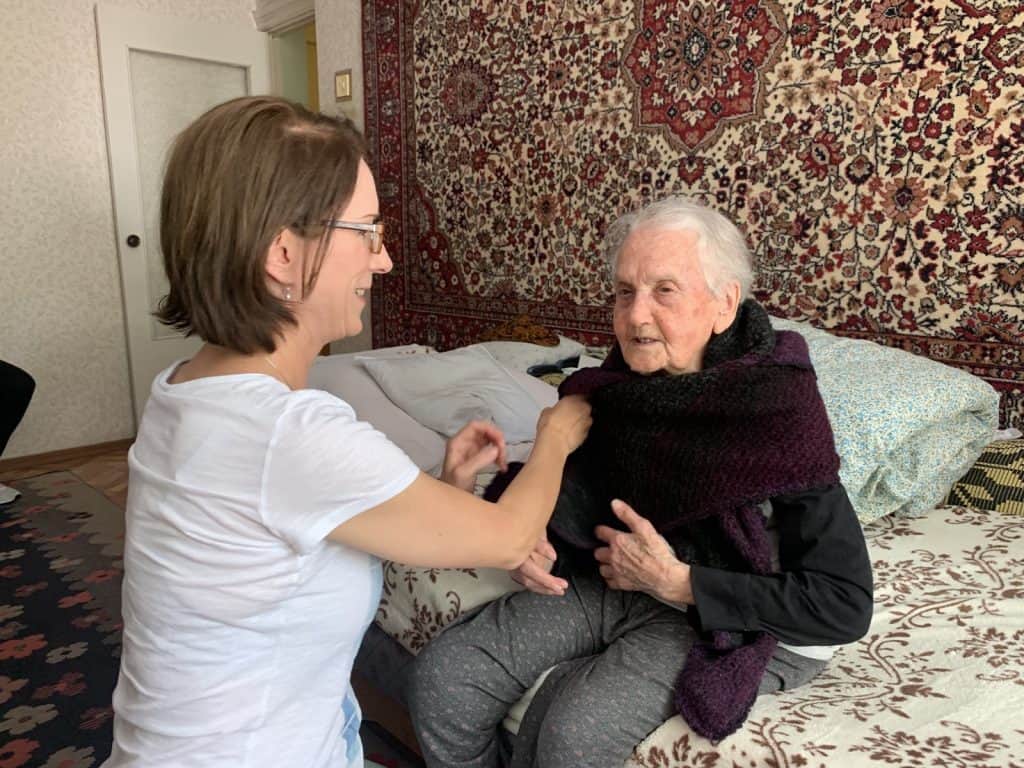
Lubow is the first woman we visit in the Belz region. She turned 100 on April 5th. On the sofa, to which her daughter leads us, she seems so fragile, as if she could be lifted with one hand. Yet her mind is sharp, and she straightens up expectantly for her guests.
She was born in 1922 in this village, Drokia. Her father, Isaac, was a tailor. Her mother dyed the most beautiful fabrics. "Everyone in our family spoke Yiddish," Lubov recounts. "Papa died when I was four. And Mama got poisoned while dyeing fabrics." She died when Lubov was 14. From then on, the older siblings had to take care of the younger ones.
"Then there was war. They herded us all into a camp, to Kodyma. On the way, my brother Avram couldn't go any further. He had become ill. So they shot him. They shot his whole family, his wife and his two sons.".
They drove us from place to place
My sister came to the camp with me too. I carried her little girl in my arms. She was two. She starved to death. She died in my arms on the way,” Lubow recounts. The memories bring tears to her eyes.
"They drove us from place to place – across the Dniester to Transnistria. We completely lost track of time. But once a car stopped in a village. They were German soldiers. One of them gave me two loaves of bread and vitamins. They had things like that too. I was so happy about this gift. I immediately shared it with my sister."
“I’ve been through so much,” Lubov says again and again. “So many terrible things…” She and her family were driven from camp to camp. “For a month we lived in the open air in the forest. Then we had to build roads… One day I was shot. I thought it was all over. But then a Ukrainian woman saved me. She took me home and cared for me. And then she helped me escape further. My whole family died. Only my youngest brother survived. The Russians captured him and thought he had deserted. So they imprisoned him. And that’s how he survived.”
But Lubow ("Love") has not become bitter. She comes to this astonishing conclusion about her difficult life:
"Today I have two daughters, three grandchildren and three great-grandchildren. Everything I lost in my youth, God has given me back in my children and grandchildren."
And then she had some special information for us: “I dreamt on Sunday that you were coming. That a woman came and wrapped me in a beautiful cloth. God sent you. I certainly don't deserve for anyone to want to see me. It amazes me. And it's so wonderful for me.”