

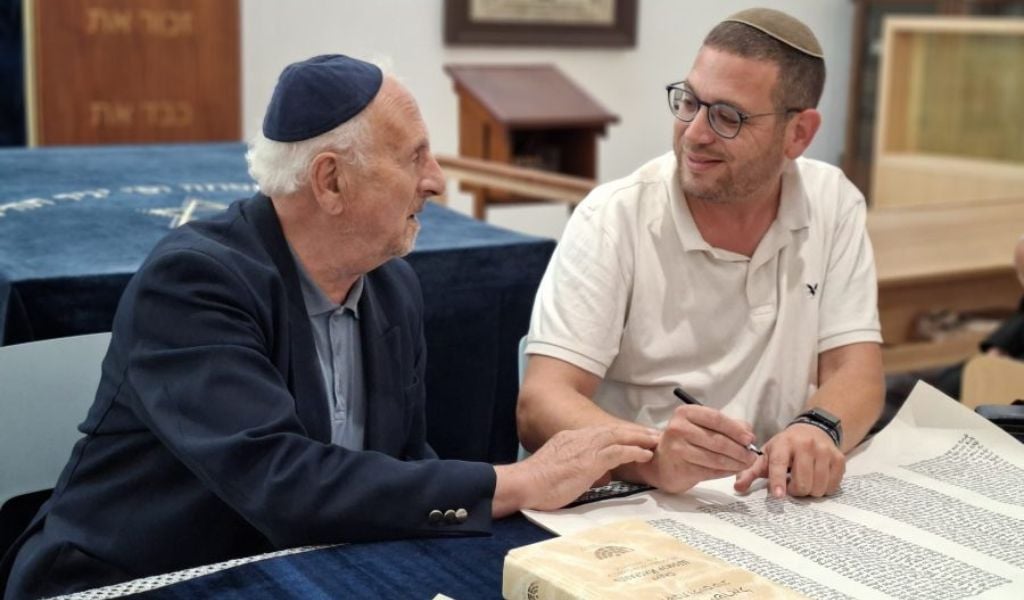
Magdeburg – Hamburg – Kiel – Rostock – four stops for a unique project: In cooperation with the Central Welfare Board of Jews in Germany (ZWST), Christians Standing with Israel (CSI) numerous Holocaust survivors in northern Germany to contribute to a Torah scroll dedicated to the memory of those murdered on October 7th. It is scheduled to find its new home next spring in the rebuilt Kibbutz Kfar Aza.
By Anemone Rüger
“If a letter is missing, is a Torah scroll still usable?” Yehuda Alon asks his audience at the synagogue in Magdeburg. The Torah scribe, called a sofer in Hebrew, has traveled from Israel to share his passion project with Holocaust survivors in the Jewish communities of Northern Germany. The people of Magdeburg are familiar with the subject – just a few months ago, a new Torah scroll was ceremonially consecrated here. “No, of course not – then the Torah scroll isn’t kosher!” Rabbi Igor Mendel Itkin translates from Russian back into Hebrew for the guest of honor.
It's not just any Torah scroll. It began with a friendship between Yehuda Alon, who 20 years ago painstakingly fought his way back to life emotionally after one of Israel's wars, and Ofir Libstein, most recently the governor of the Sha'ar HaNegev region in the Gaza Strip. Libstein believed that everyone in the Jewish people, and ultimately in all of creation, has a place they must occupy; otherwise, something is missing. Just as none of the 304,805 letters in the Torah can be missing. "Ani ot echad, kulanu am echad" – "I am a letter, we are a people" – was his guiding principle. Engaging with the Torah and the art of Torah writing brought Alon back to life and gave him a mission: to connect people from diverse backgrounds with the Torah.

Libstein's legacy
Libstein was the first to be reported killed in action from Kibbutz Kfar Aza on October 7th. He, who, like few others nationwide, had championed improving living conditions for the Palestinian neighbors in Gaza, was targeted and eliminated by Hamas terrorists before the rest of the kibbutz was devastated and its inhabitants murdered. A bracelet was found on his body: "Ani ot echad, kulanu am echad." Each letter, together a people.
Now Sofer Yehuda Alon carries it – and with him, more than 33,000 people whom he has involved in his mission, from kindergarteners to the elderly: to write a Torah scroll in memory of his friend Ofir Libstein. Today, it is the Magdeburg Holocaust survivors of the synagogue community. But actually, no one comes from Magdeburg.
From Marx and Lenin to the Torah
“We all grew up in the Soviet Union,” says Channa from St. Petersburg. “Everything was forbidden. Even saying the word ‘synagogue’ was dangerous. And now you are giving us the opportunity to participate in this special day, to even contribute to a Torah scroll!”
Diana from Kyiv is happy about our reunion – a few months ago a small CSI team was in the community to give all the survivors flowers and liqueur.
“I started learning Hebrew with my husband back then. At first, we wanted to go to Israel,” Diana said. “But that was too complicated. So we set our sights on America and learned English for a month. Finally, 23 years ago, we came to Germany, to Magdeburg. We lived well here. I’m widowed now. Today’s event means a lot to me. My parents were atheists, as was common in the Soviet Union. My grandfather David died in the war, and I was named Diana in his honor. But my grandmother kept her faith. Every Passover, she secretly baked matzos. She observed all the holidays.”

Standing together in challenging times
“Thank you to our friends at CSI – for standing with us, defending us! It means so much to us, especially right now!” says community leader Inessa Myslitska. “This event after yesterday’s election Sunday is no coincidence,” says Rimma Fil, managing director of the State Association of Jewish Communities of Saxony-Anhalt. “Everyone is somehow speechless, frozen in shock. This event is our response.”
The Torah as a connecting element between Jews and Christians, the inclusion of Holocaust survivors, and the connection to Kibbutz Kfar Aza, where the Torah scroll will find its home after the community's return next year: "If we had done extensive brainstorming to find a project that unites all our core issues, we couldn't have landed in a better place," said the new CSI chairman, Christian Frach.
Jews and Christians – united by the Torah
“After the event in Kiel, the five of us sat together for a kosher dinner,” recounts Raquel Schwärzler, a CSI staff member in the aid projects department. “A rabbi, two other Jewish people, a Christian woman who came to Germany from Ukraine, and myself. Five people from different countries, cultures, and life stories. Our conversation centered on how different religions and legal systems can divide people. And I thought: What a special image, Jews and Christians sitting together at one table. How wonderful that we can sit together, listen to each other, and share a meal together so naturally.”.
For me, that was precisely the message of this evening with Rabbi Yehuda Alon: Every life is as precious as a letter in the Sefer Torah. Every person has their place in the Book of Life. What a gift from God.”

“After I had written down a letter, Yehuda said to me, ‘Now you are also a part of it.’ That was very moving for me,” said CSI Chairman Christian Frach. “We experienced the Torah as a unifying element between Jews and Christians. The fact that we were allowed to become part of this Torah scroll, which will find its place in Kfar Aza, on behalf of CSI, connects us in a profound way – with Israel, the Torah, and also the community of Kfar Aza.”
The Central Welfare Board of Jews in Germany (ZWST) hosted the Magdeburg – Hamburg – Kiel – Rostock tour. It is financially supported by Christians Standing with Israel (CSI).